10 Most Beautiful Angel Paintings in Art History

Art historians pick well-known angel paintings by looking at balance, harmony, and unity. They study each angel painting for how it is arranged, its colors, and how it makes people feel. Beautiful angel paintings use light well, have soft colors, and show angels that look real. Artists have painted angels for a long time, and you can find angel art in both old and famous religious paintings. Many well-known angel paintings show holy figures that make people feel inspired. Angels in art are still interesting, and artists use special ways to show their angelic and spiritual sides.
Key Takeaways
Angel paintings use light, color, and real details to show purity, hope, and protection. Artists from many times painted angels to show faith, feelings, and spiritual messages. Famous angel paintings like The Sistine Madonna and The Guardian Angel inspire people all over the world. Angel art changed over time from simple shapes to detailed, glowing beings with wings. These paintings help us connect with history, culture, and the idea of angels as messengers.
1.The Sistine Madonna
Artist
Raphael painted The Sistine Madonna between 1512 and 1514. He was a famous artist from the Italian Renaissance. Pope Julius II asked Raphael to make this painting for a church in Piacenza. Raphael was known for mixing classic beauty with deep meaning. He made this angel painting when artists wanted to show more emotion and real life in their work.
Details
The Sistine Madonna shows Mary holding baby Jesus. Saint Sixtus and Saint Barbara stand beside them. Two cherubs rest their arms at the bottom and look up. These cherubs are very famous in art history. Many people call this painting "virgin and child with angel" because of the angels. Raphael added the cherubs later to balance the painting. He wanted to show a line between heaven and earth. Some say he got ideas for the cherubs by watching kids in his studio or outside. The cherubs look natural and thoughtful, which makes them special.
The cherubs stare at Mary and Jesus with amazement. They invite people to feel the same wonder.
Impact
The Sistine Madonna has inspired many angel paintings in Europe. The cherubs became famous and are seen on stamps and clothes. Artists and writers like Goethe and Wagner loved this painting. This helped it become well known everywhere. Augustus III of Poland bought the painting in 1753. He put it in Dresden, and more people saw it. The painting moved from a church to a museum over time. This changed how people thought about it. Today, the cherubs stand for innocence and curiosity. Their faces still inspire artists and people around the world.
2.Angel by Abbott Handerson Thayer

Artist
Abbott Handerson Thayer was an American painter in the late 1800s. He became famous for painting angels in a new way. Thayer often used his family as models for his art. His daughter Mary was the model for his first angel painting in 1887. Thayer wanted to show more than just beauty in his work. He tried to show purity and goodness in his paintings. Many people thought he was an important American artist at that time.
Details
Thayer’s painting "Angel" is special because of its style and meaning.
He painted Mary, his daughter, in a white robe with soft wings.
The angel’s arms make a triangle shape, which is common in art.
Some parts of the painting are not finished, so it looks modern but also classic.
The angel’s face is calm and gentle, not too dramatic or sweet like other angel paintings from that time.
Thayer wanted to show the angel’s spirit by keeping things simple and soft.
He used light and gentle colors to make the painting look dreamy.
Thayer’s angels are not just pretty. They seem to float above normal life and show peace and a higher goal.
Impact
"Angel" by Thayer changed how people saw angels in American art.
Thayer put wings on his figures to make them look special and not just normal people.
His angels stood for goodness and safety, not just looks.
Some critics thought the painting was too emotional, but others liked its calm and new style.
Thayer’s angel paintings helped other artists mix real life with spiritual ideas.
His work made people think of angels as both protectors and something greater.
Now, many people see his angel painting as a sign of hope and goodness.
3.Depicting Angels: The Annunciation by Petrus Christus
Artist
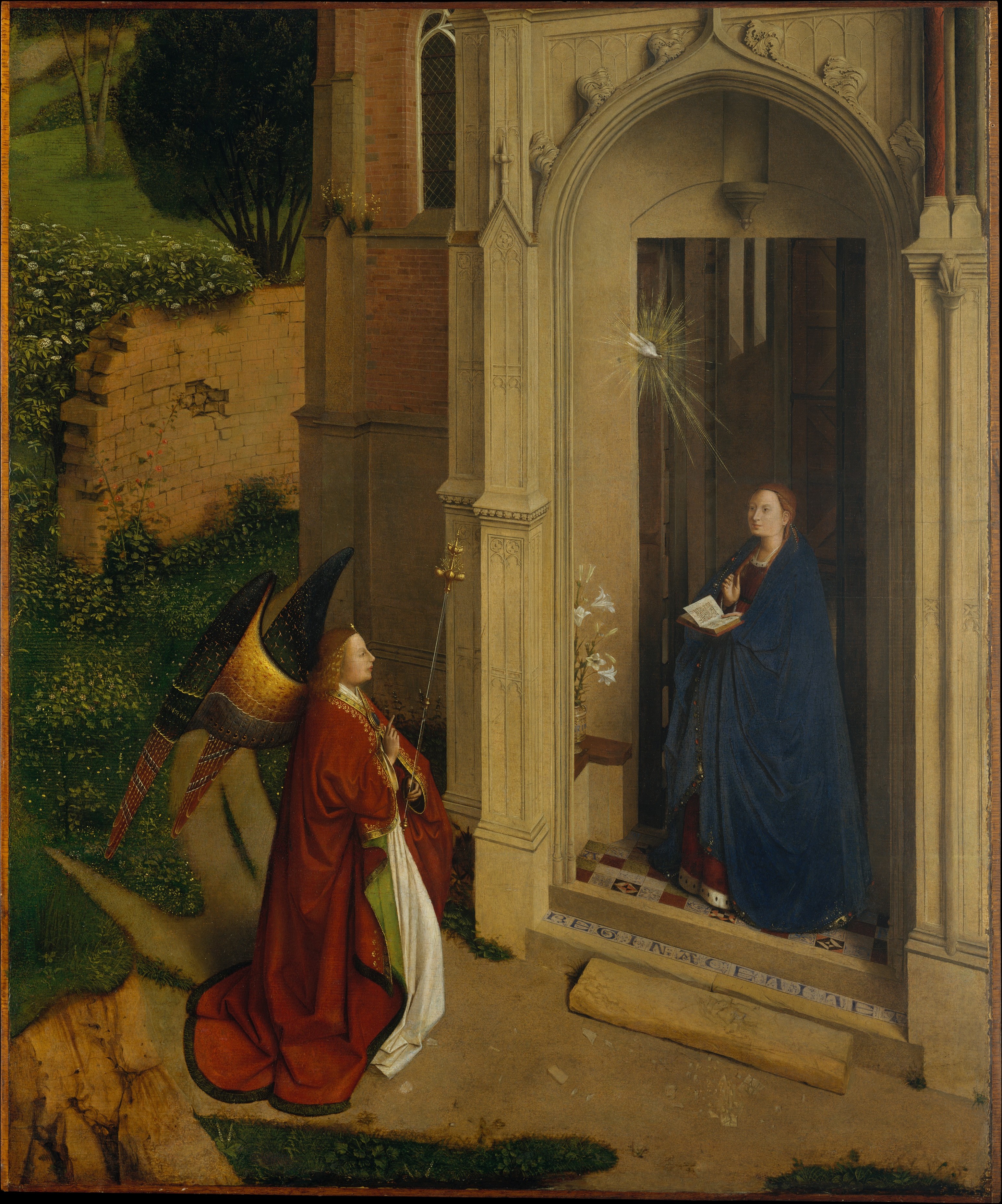
Petrus Christus was a painter in Bruges in the 1400s. He was famous for his careful style and bright use of light. Many experts think he was important in the Northern Renaissance. He learned from Jan van Eyck and added new ideas to religious art. His paintings showed real faces and detailed textures. Christus made several renaissance paintings of angels that are known for their beauty and accuracy.
Details
The Annunciation by Petrus Christus shows Gabriel visiting Mary. This story is in many renaissance paintings of angels, but Christus made his version different. Gabriel has colorful wings and a soft look on his face. Mary sits quietly and looks surprised and respectful. Light shines in the room and makes the people glow. The artist used strong colors and tiny details in the clothes and background. Gabriel looks calm and graceful, which makes this painting special. The room looks like a real house from that time, so people can relate to the story.
The painting makes people stop and think about the meeting of heaven and earth.
Impact
This painting became one of the most famous angel paintings from the Northern Renaissance. Artists liked how Christus showed angels as both real and spiritual. The Annunciation helped later artists show angels as both holy and human. Many people see this painting as a great example of how renaissance paintings of angels mix faith and daily life. Museums and books often show this painting when talking about the history of paintings of angels. The way Gabriel looks in this painting still inspires artists and viewers today.
4.The Conversion of Saul

Artist
Michelangelo painted "The Conversion of Saul" from 1542 to 1545. He made this artwork for the Pauline Chapel in the Vatican Palace. Pope Paul III asked him to paint it. Michelangelo was already famous for the Sistine Chapel ceiling. He used his talent to show a big moment from the Bible. He liked to paint strong people and big feelings. In this painting, he used bright colors and lots of movement. This style shows how his art changed later in his life.
Details
"The Conversion of Saul" shows Saul seeing a vision on the road to Damascus. Michelangelo made the scene full of action and excitement. Saul falls off his horse because a bright light blinds him. Angels fill the sky above and watch what happens. They also protect Saul during this moment. The angels look amazed and scared at the same time. This helps show that something special is happening. Michelangelo used big movements and strong bodies to make the scene feel real and important.
Aspect |
Details |
|---|---|
Commission and Location |
Pope Paul III asked for this painting for the Pauline Chapel in the Vatican Palace, built in the late 1530s. |
Biblical Scene Depicted |
Saul’s change on the road to Damascus, when Christ steps in. |
Angelic Depiction |
Angels are shown as amazed watchers and as a shield between heaven and earth. |
Artistic Style |
The painting has big poses, strong bodies, and faces that show strong feelings. |
Symbolism |
Saul stands for a person who needs God’s light; the bright beam and the way the painting is set up show his change. |
Historical Context |
Saul (Paul) was a Pharisee from the tribe of Benjamin and a Roman citizen who changed from enemy to helper. |
Theological Significance |
The angels show that God is helping, bringing hope and change to people. |
Impact
Michelangelo’s painting is special because it shows strong feelings and tells a story. The scene shows how art can capture a moment that changes someone’s life. Saul’s change from enemy to leader became a sign of hope and new beginnings. The angels remind people that messengers from God are important in history.
Saul was from the tribe of Benjamin and worked as a Pharisee.
He was a Roman citizen, so he could talk to many people as Paul.
Before he changed, Saul hurt Christians, like King Saul chased David.
The road to Damascus was the perfect time for God to step in.
Artists like Michelangelo and Caravaggio liked this story because it is exciting and meaningful.
St. Paul’s story is still important in Christian art and tradition.
Michelangelo’s "The Conversion of Saul" still inspires people with its message about change and the strong presence of angels.
5.Saint Francis of Assisi in Ecstasy

Artist
Caravaggio painted "Saint Francis of Assisi in Ecstasy" around 1595. He was famous for using strong light and shadow, called chiaroscuro. Caravaggio liked to use real people as models. This made his paintings look very real. He worked in Rome during the Baroque period. Artists then wanted to show deep feelings and spiritual moments. Caravaggio’s style changed how others saw religious art.
Details
This painting shows Saint Francis getting the stigmata, which are Christ’s wounds. An angel gently holds him in a calm hug. Caravaggio did not paint the angel with six wings. He gave the angel only two wings, so it looks more human. The angel is big and calm, making Saint Francis feel safe. Caravaggio used strong light and dark to make the figures stand out. This lighting makes the scene glow and shows the bond between the saint and angel.
The angel’s young face and relaxed pose make it feel real.
Caravaggio did not use fire or wild action, but showed feelings and closeness.
The painting tells about spiritual change with soft light and gentle moves.
Caravaggio’s light and the angel’s caring touch show the Baroque love for deep feelings and real life.
Impact
"Saint Francis of Assisi in Ecstasy" changed how artists painted after Caravaggio. He showed mystical moments as quiet and personal. This became popular in religious art. Other painters, like Francisco de Zurbarán, also showed saints in simple, strong ways. Giovanni Bellini’s earlier work put Saint Francis in nature, using sunlight and animals to show God’s presence. Over time, artists made over 20,000 pictures of Saint Francis. Each one showed new ideas about faith and spirit. This painting is still one of the famous angel paintings that shaped how people see angels and saints in art. Museums and shows still display these works, showing their lasting effect on artists and viewers.
6.The Triumph of Victory
Artist
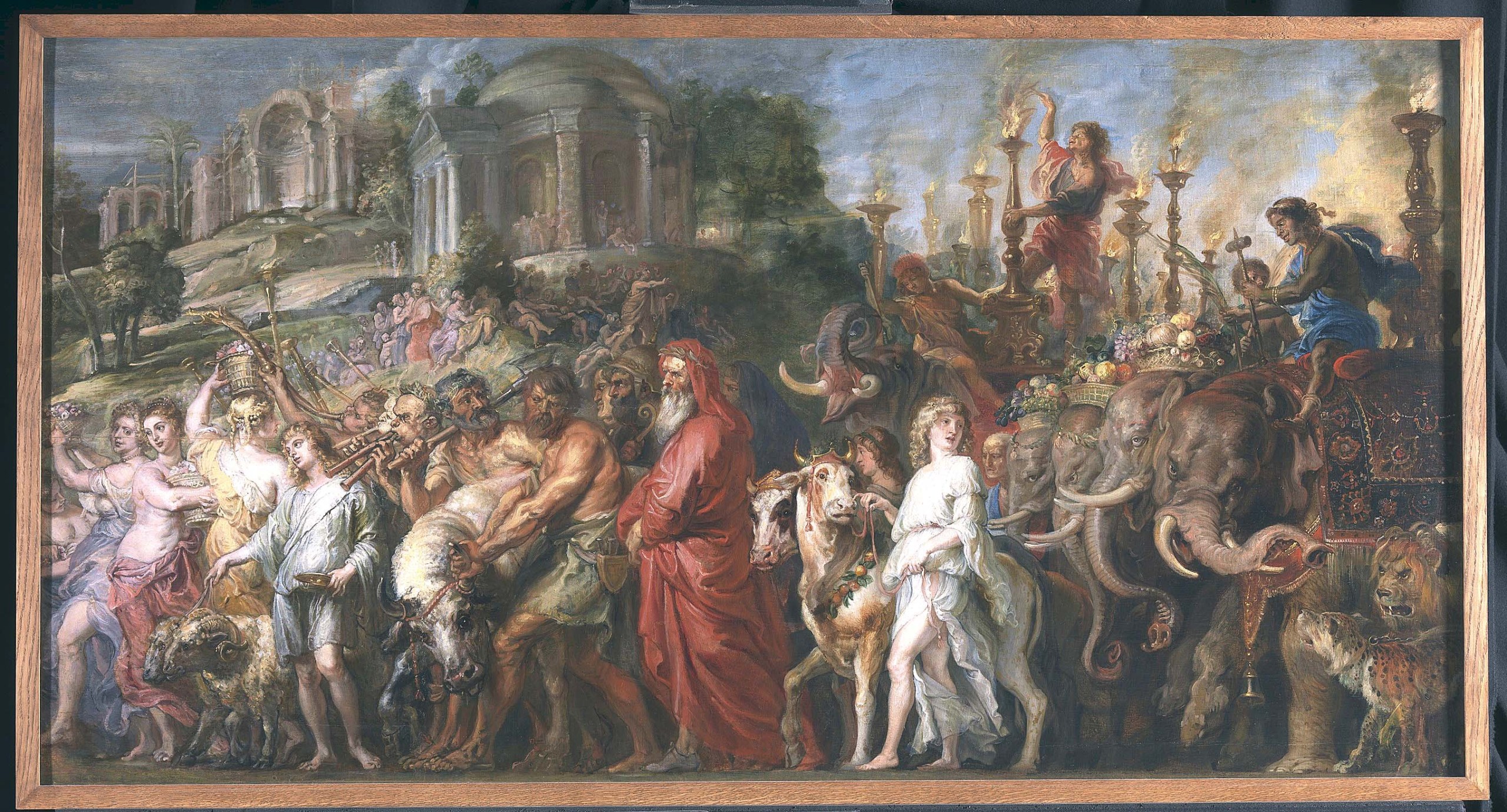
Andrea Mantegna made "The Triumph of Victory" for his big art series called The Triumphs of Julius Caesar. Mantegna lived during the Italian Renaissance. He loved learning about ancient Rome. He painted this series from 1484 to 1492. No one paid him to do it. He chose to paint it because he liked Roman history. He wanted to show how great Rome was through his art. Mantegna looked at old Roman ruins, coins, and statues. This helped him make his scenes look real and important.
Details
"The Triumph of Victory" shows a parade for a big military win. Mantegna filled the painting with soldiers, musicians, and prisoners. In the middle, Victory stands tall. She holds a palm branch and puts a crown on the winners. Mantegna got ideas from many places:
Ancient writers like Suetonius and Plutarch wrote about Julius Caesar’s parades.
Books by Livy and Appian talked about Roman celebrations.
Humanist scholars, like Flavio Biondo, wrote about Roman ways in Roma Triumphans.
Mantegna looked at Roman art, coins, and medals to make his scenes look real.
The painting also uses ideas from Greek myths. The goddess Nike, or Winged Victory, is shown as a young woman with wings. She gives crowns made of leaves or palm branches to the winners. The famous statue, Nike of Samothrace, stood in a temple for secret ceremonies. Mantegna used these signs to show both winning in war and being blessed by the gods.
Source/Subject |
Description |
|---|---|
Nike (Winged Victory) |
Greek goddess of victory, shown as a winged woman crowning winners. |
Nike of Samothrace |
Statue symbolizing military victory, placed in a sacred temple. |
Sanctuary of the Great Gods |
Place for secret ceremonies, where the Nike statue stood for winning and safety. |
Historical Context |
The monument marked a sea win and honored the leader’s success in front of many people. |
Impact
Mantegna’s "The Triumph of Victory" became one of the most famous angel paintings from the Renaissance. Artists and scholars liked how he mixed history, stories, and art. The painting helped people learn about Roman ways and the power of winning. Later artists copied his style and used the same signs in their own art. Museums still show this painting to connect old stories with Renaissance art. The image of Victory with wings still inspires artists and people today. It reminds everyone about the lasting power of winning and hope.
7.Paintings of Angels: The Annunciation by Fra Angelico

Artist
Fra Angelico was a painter and a Dominican friar. He lived in Florence in the early 1400s. People liked his gentle style and strong faith. Giorgio Vasari said he was a good artist and a very religious man. Fra Angelico learned the Gothic style first. Later, he mixed his faith with new art ideas. His work became a model for religious art at that time.
Details
Fra Angelico’s "The Annunciation" is special for its design and symbols. The painting shows Gabriel visiting Mary. Mary’s house opens into a garden, which stands for purity and Eden. A wooden fence marks the edge instead of a wall. The garden has plants from Florence. There is a potted carnation, a flower linked to Mary. Gabriel kneels with respect, and Mary stays calm and accepts. The garden, called hortus conclusus, shows Mary’s purity.
The garden and flowers became common in later angel paintings.
The way Gabriel and Mary act influenced many artists.
Fra Angelico used light and color to make the scene glow.
Fra Angelico’s Annunciation mixes nature and faith, making it a guide for other artists.
Impact
Fra Angelico changed how artists painted angels in the Renaissance. He used bright colors and soft faces. His angels look holy but also friendly. He used perspective and real shapes to make scenes feel true. Artists like Raphael and Rogier van der Weyden learned from him. His style spread to painters in Italy and all over Europe. Fra Angelico helped shape how people see angels in art for many years.
8.Song of the Angels

Artist
William-Adolphe Bouguereau made "Song of the Angels" in 1881. He was a French painter who paid close attention to small details. Bouguereau liked to paint stories from religion and myths. His paintings looked very smooth and real. People liked how he showed feelings and beauty in his art. In the 1800s, many artists tried new ways, but Bouguereau kept a classic style.
Details
"Song of the Angels" shows three angels playing music for baby Jesus. Mary holds Jesus while the angels stand around them. The angels wear white robes that look soft and pure. Bouguereau used bright light to make the people stand out. Baby Jesus glows and catches your eye right away. The angels play string instruments, making the scene feel calm. Bouguereau used light and soft colors to make the painting dreamy. Other artists used different ways to show angels, but Bouguereau wanted to show their gentle side. He used careful shading to make everything look peaceful.
The painting’s gentle light and quiet faces help people feel calm and amazed.
Impact
"Song of the Angels" is now one of the most famous angel paintings. Many people think it shows beauty and grace in religious art. Bouguereau’s style made other artists want to paint angels as kind and pure. Museums and churches like to show this painting as a great example of 1800s angel art. The idea of angels playing music with the holy family appears in many later paintings. Today, "Song of the Angels" still inspires people with its peaceful and pure message.
9.Famous Angel Paintings: The Guardian Angel by Plockhorst
Artist
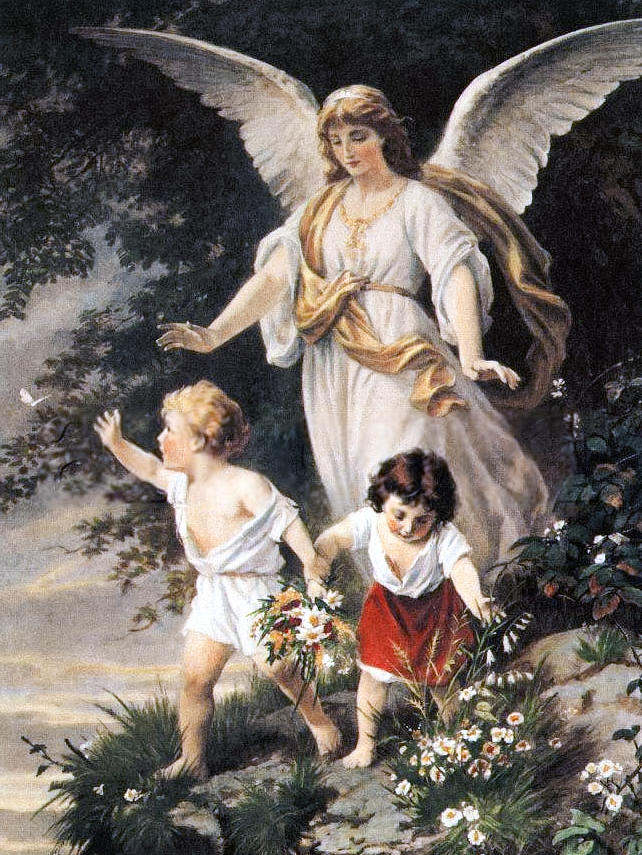
Bernhard Plockhorst was a German painter from the 1800s. He was famous for painting religious scenes with strong feelings. In 1886, he painted "The Guardian Angel." He wanted people to feel safe and cared for when they saw it. People in Europe and America liked his gentle style. He often used soft colors and light to make his angel paintings look calm.
Details
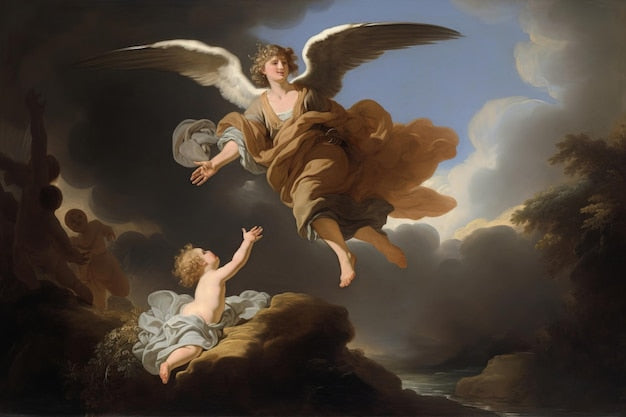
"The Guardian Angel" shows a big angel watching two kids cross a broken bridge. The angel stands behind them with wide wings and a peaceful face. The children do not see the danger, but the angel keeps them safe. Plockhorst painted the angel with flowing robes and soft light. This makes the angel look strong and kind at the same time. The painting has trees and water to help show safety and wonder. Many people notice the careful details in the angel’s wings and the kids’ faces.
This painting became a sign of hope for families and children everywhere.
Impact
"The Guardian Angel" is one of the most famous angel paintings ever. Plockhorst’s art is found in many homes, churches, and schools. Color prints made it easy for people to have copies. Many churches in the United States have stained glass windows based on this painting. For example, the Cathedral of St. Paul in Birmingham and Stanford Memorial Church both show this image. The idea of protection in the painting influenced books, cards, and movies about angels. Some people think the angel looks like a superhero, with wings like a cape and a caring look. This painting helped people picture guardian angels today. It is still one of the best-known angel paintings and inspires new art and stories about protection.
Place of Display |
Type of Reproduction |
|---|---|
American homes and churches |
Color prints |
Cathedral of St. Paul, Alabama |
Stained glass windows |
Stanford Memorial Church |
Stained glass windows |
Plockhorst’s painting is still a model for angel art and helps artists and filmmakers show angels today.
10.Early Angel Painting: Catacomb of Priscilla
Artist
No one knows who painted the angel art in the Catacomb of Priscilla. Early Christians in Rome made these wall paintings together around the year 250. They worked as a group to decorate the underground tombs. The artists did not put their names on the art. They wanted to tell Bible stories and show their faith with simple pictures. The Catacomb of Priscilla is one of the oldest places with Christian art. It has some of the first angel images ever made.
Details
The Annunciation painting in the Catacomb of Priscilla shows an important event. Mary wears Roman clothes and looks like a busy woman. She is spinning thread. Gabriel stands next to her. He does not have wings. He wears fancy Roman clothes and points at Mary. The scene is quiet and close, with no extra things in the background. This style makes the meeting feel real and special. The artists used simple lines and shapes. They wanted to show something holy happening in normal life.
The angel in this painting looks like a real person. This helps people feel close to the story.
Impact
The angel art in the Catacomb of Priscilla was important for later Christian art. Early Christians painted angels as people without wings. They used simple signs to share spiritual ideas. Later, artists changed how angels looked. In the Middle Ages, angels had wings and wore fancy clothes. In the Renaissance, artists made angels look even more real and beautiful. They gave them colorful wings and detailed faces.
Aspect |
Catacomb of Priscilla (3rd century) |
Renaissance Paintings |
|---|---|---|
Form |
Human-like figures without wings or distinct features |
Winged young men or cherubic figures, often modeled on real people |
Symbolism |
Symbolic and allusive, emphasizing immaterial and spiritual nature |
Wings symbolize speed, transcendence, and divine mission |
Artistic Influence |
Early Christian art with limited biblical description |
Influenced by Classical Greco-Roman and Near Eastern iconography |
Representation Style |
Abstract, symbolic, minimal physical attributes |
Naturalistic, detailed, emphasizing beauty and emotional expression |
Purpose |
Reflects theological ideas of angels as spiritual messengers |
Standardized iconography integrating angels into naturalistic religious scenes |
The angel paintings in the Catacomb of Priscilla show that art changes over time. Early Christian artists cared about faith and kept things simple. Later artists added more symbols and made angels look more beautiful. Today, people can visit the catacombs and see how the first Christians pictured angels—plain but meaningful.
People have always been interested in angels in art. Artists often paint angels as glowing and with wings. Angels stand for purity, hope, and protection.
Many paintings use light and white robes to show angels are from heaven.
Wings, rivers, candles, and music are symbols in these paintings.
These things help tell stories about faith and life.
Angel Art Style |
Cultural Meaning |
|
|---|---|---|
Renaissance |
Realistic, bright, detailed |
Humanism, faith, church values |
Baroque |
Dramatic, emotional, glowing |
Inspire faith, show God’s power |
Modern |
Mix of old and new, symbolic |
Connect past and present |
These famous paintings still inspire artists and people today. Looking at angel art in museums or books helps people learn about art and spiritual ideas.
Tucocoo Fairy Paint by Numbers
FAQ
What do angels symbolize in art?
Angels often stand for purity, hope, and protection. Artists use them to show messages from heaven. Many people see angels as signs of comfort and faith.
Why do artists paint angels with wings?
Wings help show that angels come from heaven. They also mean speed and the power to move between worlds. Artists use wings to make angels look special and different from people.
Which angel painting is the most famous?
Many people know Raphael’s cherubs from "The Sistine Madonna." These two angels appear in books, on stamps, and in homes. They have become a symbol of innocence and wonder.
How did angel paintings change over time?
Period |
Angel Style |
|---|---|
Early Christian |
Simple, no wings |
Renaissance |
Realistic, with wings |
Modern |
Symbolic, varied |
Artists changed how angels look to match new ideas and styles.